Friction story 03 · Focused cleaning
Catch the Small Mess
The snack is gone. Its crumbs have established several small, determined outposts.
Category guidance · Follow surface and appliance care instructions
Identify what you are collecting
Crumbs on a table, powder in a drawer and a damp splash near a laptop may look like variations of “a small mess.” They need different responses. Choosing by appliance size alone is a good way to buy a neat-looking tool that cannot safely handle the thing you actually spill.
For ordinary dry crumbs on a robust surface, a brush can be enough. For liquid, use a method suitable for the surface and keep electricity out of the equation. A dry-only vacuum is not a wet-cleaning tool, however small the spill. Fine powders may clog filters or escape from equipment not designed for them.
Do not use a general handheld vacuum for hot ash, flammable material or hazardous dust. Broken glass and sharp debris also require specific care and equipment instructions. This guide concerns everyday, non-hazardous mess, not specialist cleanup.
Attempt one: use the quiet option
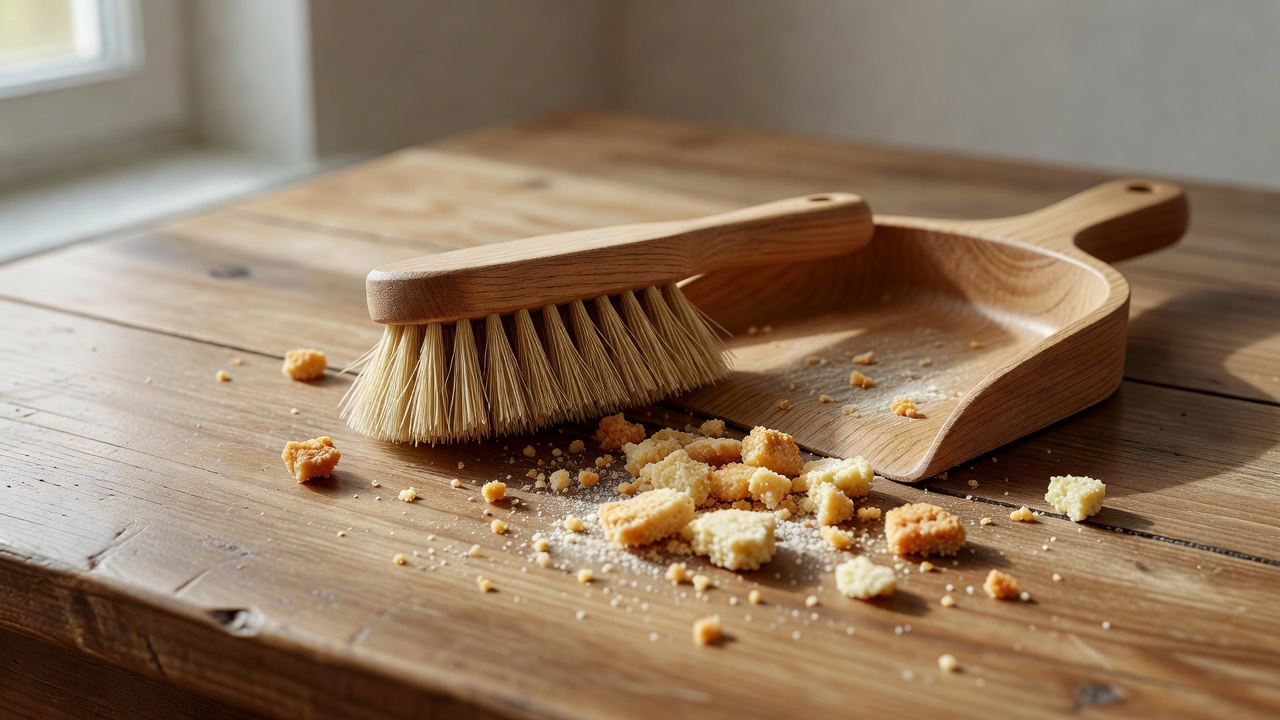
A small brush and dustpan are easy to understand. They do not need charging, pair with no app, and tend not to announce your afternoon snack to the whole room. The details still matter: soft bristles, a dustpan lip that meets the surface, and handles you can comfortably hold.
If you already own a suitable brush, test that first. Sweep gently into a container rather than simply sending crumbs from the desk to the floor. For a wipeable surface, a slightly damp cloth may collect the remaining residue, provided that the surface-care instructions allow it.
Electronic equipment needs more restraint. Power down and disconnect equipment as its manufacturer advises, and follow its cleaning instructions. Do not assume that an ordinary brush, vacuum nozzle or cleaning liquid is safe for exposed ports and delicate components. Pushing debris deeper into a keyboard is not a particularly useful form of tidying.
Judge the complete cycle, including the part after the visible crumbs have disappeared.
Attempt two: add suction for a reason
A handheld vacuum becomes more plausible when crumbs collect in seams, on upholstery or in another place where a brush is awkward. Compare the nozzle shape with the actual space. A wide inlet is no help inside a narrow groove; a narrow nozzle may repeatedly block on larger debris.
Look beyond a single suction figure. Published measurements may use different conditions, and the practical result depends on airflow, nozzle design, filter condition and the surface. A demonstration on a perfectly smooth table does not establish performance on a fabric chair.
Battery runtime deserves context too. Check which power setting the figure refers to and whether that setting is adequate for your task. If a device needs a proprietary charging lead, losing it creates another small-friction story. A replaceable battery can be useful, but only if replacement parts are actually offered for the model.
Noise, vibration and weight can matter more than a modest difference in pickup. Someone working in a shared room may prefer a brush even if a vacuum is faster. A trigger that must be held continuously may be uncomfortable; a latching control may be easier, depending on the user.
The mess has not disappeared if you have merely transferred it into something more difficult to empty.
The filter is part of the product
Before buying, find the emptying and filter-cleaning instructions. Can the container be opened over a bin without putting fingers into the dust? Are filters washable, replaceable, or both? A washable filter normally needs to dry fully as instructed before refitting. Guessing here can damage the appliance.
HEPA refers to a filtration classification, but the presence of a HEPA-labelled filter does not by itself prove that the whole appliance is sealed or suitable for a particular health need. Look for meaningful evidence about the complete system. The United States Environmental Protection Agency, or EPA, provides broader context on indoor particles; it does not endorse every household product using filtration language.
Factor in consumables and availability. A cheap vacuum with an unobtainable filter can become waste remarkably quickly. Check local electrical-recycling routes when a battery appliance reaches the end of its useful life. Do not place damaged lithium batteries in ordinary household waste.
Keep the tool that shortens the whole job
Try to include retrieval, cleaning, emptying and putting away when judging convenience. A thirty-second pickup followed by several minutes of dismantling is not necessarily a victory over a brush. Equally, a tool that makes a previously avoided task manageable can be worth its maintenance.
Give the chosen tool one sensible home, away from food preparation items if it is used for dirty surfaces. Avoid buying a different miniature cleaner for every room before establishing that the first one helps. Small appliances can occupy a surprisingly large amount of mental shelf space.
Keep it if the recurring mess is handled safely and comfortably with less total effort. Otherwise, the ordinary brush remains a perfectly respectable piece of technology.
For broader safety and care context, consult the EPA’s indoor-air information, the U.S. Consumer Product Safety Commission and your appliance manual.